The flights went through Abu Dhabi and landed at Ben Gurion Airport, near Tel Aviv. Jerusalem is about an hour away by road.
“Then the LORD said to Abram, “Leave your country, your kindred, and your father’s household, and go to the land I will show you.”
Abu Dhabi airportLanding at Ben Gurion
First Night in Jerusalem
Gates, alleys and stone after dark
Damascus Gate
The main northern entrance to the Old City. The gate seen today dates to 1537, built by Suleiman the Magnificent over older Roman foundations. It is busy at night as well as by day.
“Our feet are standing in your gates, O Jerusalem.”
Tower of David (the Citadel)
The Citadel has stood beside Jaffa Gate for over two thousand years. Byzantine Christians mistook one of its towers for David's palace and the name stuck. The minaret is Ottoman.
“March around Zion, encircle her, count her towers, consider her ramparts, tour her citadels, that you may tell the next generation.”
Damascus GateDamascus Gate at nightThe Old City marketTower of David after dark
Qumran & Masada
The Judean Desert and the Dead Sea
Qumran
The Dead Sea Scrolls were found in the caves around this settlement in 1947, hidden for nearly two thousand years. They include the Great Isaiah Scroll. The community that lived here is most often identified with the Essenes.
“The grass withers and the flowers fall, but the word of our God stands forever.””
Masada
Herod the Great built palaces on this isolated rock in the first century BC. After Jerusalem fell, Jewish rebels held it against Rome until 73 or 74 AD, according to Josephus. The Roman siege ramp is still visible on the western side.
“And David stayed in the wilderness strongholds and in the hill country of the Wilderness of Ziph. Day after day Saul searched for him, but God would not deliver David into his hand.”
The Dead Sea
The lowest land surface on Earth, more than 400 metres below sea level. Its salinity is about ten times that of the ocean, so nothing lives in it.
“And he said to me, “This water flows out to the eastern region and goes down into the Arabah. When it empties into the Dead Sea, the water there becomes fresh.”
QumranModel of Masada, Masada museumCable car up to MasadaFrescoes at MasadaView from MasadaThe Dead Sea
Jerusalem at Dusk
Evening light over the city
At the Tower of David
Herodium
Herod's fortress hill
Herodium
Herod the Great built this palace-fortress on a man-made cone of earth south of Bethlehem, around 23 to 15 BC. Archaeologist Ehud Netzer announced the discovery of Herod's tomb on the slope in 2007. Tunnels beneath the hill date to the Jewish revolts against Rome.
“After Jesus was born in Bethlehem in Judea, during the time of King Herod, Magi from the east arrived in Jerusalem,”
HerodiumView from Herodium
The Old City
Rooftops, columns and the Western Wall
The Western Wall
A surviving stretch of the retaining wall of the Temple Mount platform that Herod the Great expanded. It is the holiest place where Jews can pray. People tuck written prayers into the gaps between the stones.
“Pray for the peace of Jerusalem: “May those who love you prosper.”
The Western WallChurch of the Holy SepulchreCalvaryThe Edicule
Down the Jordan Valley
On the road to the river
The Jordan Valley
The road drops from Jerusalem into the Jordan Valley and the Judean wilderness. The traditional site of Jesus' baptism is on the Jordan near Jericho.
“At that time Jesus came from Galilee to the Jordan to be baptized by John.”
The wilderness canyons
The canyons near Wadi Qelt cut through the desert between Jerusalem and Jericho, the road the parable of the Good Samaritan describes.
“Even though I walk through the valley of the shadow of death, I will fear no evil, for You are with me; Your rod and Your staff, they comfort me.”
Nazareth
The Basilica of the Annunciation and the old town
Basilica of the Annunciation
Completed in 1969, the largest Catholic church in the Middle East. Its lower level shelters a grotto traditionally venerated as Mary's home. Mosaic and relief panels from many countries line the walls and courtyard.
“So the angel told her, “Do not be afraid, Mary, for you have found favor with God. Behold, you will conceive and give birth to a son, and you are to give Him the name Jesus.”
The old town
Nazareth was a small village in the first century. The Gospels place Jesus' childhood here. Today it is the largest Arab city in Israel, with narrow market lanes below the hillside.
““Can anything good come from Nazareth?” Nathanael asked. “Come and see,” said Philip.”
Basilica of the AnnunciationInside the dome of the Basilica
Sepphoris
Tzippori: Roman mosaics, streets and the theater
Zippori (Sepphoris)
A Roman and Byzantine city a few kilometres from Nazareth, the capital of Galilee under Herod Antipas. It is known for its mosaic floors, including the Dionysus mosaic nicknamed the Mona Lisa of the Galilee, and for its Roman theater.
“You are the light of the world. A city on a hill cannot be hidden.”
Mount Precipice over the Jezreel ValleyModel of ancient SepphorisRoman street and mosaic floorMosaic floor detailNile Festival buildingThe Dionysus mosaicThe theater and Crusader citadel
The Sea of Galilee
Arbel, Tabgha, Capernaum, Magdala and the shore
The lake
Also called the Kinneret or Lake Tiberias. It is about 21 km long and lies roughly 210 metres below sea level. Many of the Gospel stories are set along its northern shore.
“As Jesus was walking beside the Sea of Galilee, He saw two brothers, Simon called Peter and his brother Andrew. They were casting a net into the sea, for they were fishermen. “Come, follow Me,” Jesus said, “and I will make you fishers of men.””
Mount Arbel
A cliff that rises steeply above the western shore. The overlook shows the whole lake, Tiberias, and the Golan Heights beyond.
“Then Jesus got up and rebuked the wind and the sea. “Silence!” He commanded. “Be still!” And the wind died down, and it was perfectly calm.”
Tabgha
The Church of the Multiplication of the Loaves and Fishes stands here. Its fifth-century mosaic floor shows a basket of loaves flanked by two fish, among the birds and plants of the Galilee.
“Then Jesus took the loaves and the fish, gave thanks, and distributed to those who were seated as much as they wanted.”
Capernaum
Jesus' base during his ministry in Galilee. The white limestone synagogue dates to the fourth or fifth century and stands beside the black basalt ruins of the village. A modern church is built over a house traditionally identified as Peter's.
“Then Jesus and His companions went to Capernaum, and right away Jesus entered the synagogue on the Sabbath and began to teach.”
Mount of Beatitudes
The hillside above the lake where the Sermon on the Mount is traditionally placed. The Franciscan church, designed by Antonio Barluzzi and finished in 1938, is eight-sided for the eight beatitudes. Each window carries one of them in Latin.
““Blessed are the poor in spirit, for theirs is the kingdom of heaven. ... Blessed are the peacemakers, for they will be called sons of God.”
Magdala
A first-century fishing town on the lake and the traditional home of Mary Magdalene. Excavations since 2009 uncovered a synagogue and the Magdala Stone. The modern Duc in Altum church has an altar shaped like a boat, facing the water.
“as well as some women who had been healed of evil spirits and infirmities: Mary called Magdalene, from whom seven demons had gone out,”
Hippos (Sussita)
A Greco-Roman hilltop city on the eastern shore and one of the Decapolis cities. It was abandoned after the earthquake of 749.
“So the man went away and began to proclaim throughout the Decapolis how much Jesus had done for him. And everyone was amazed.”
Chorazin
A village built from black basalt, with the remains of a synagogue. The Gospels name it among the towns where Jesus did many of his works.
““Woe to you, Chorazin! Woe to you, Bethsaida! For if the miracles that were performed in you had been performed in Tyre and Sidon, they would have repented long ago in sackcloth and ashes.”
The Sea of Galilee from Mount ArbelOn the Sea of GalileeMoonlight on the Sea of GalileeCapernaumMount of BeatitudesMosaic at TabghaMagdalaHippos (Sussita)Chorazin
Golan Heights & Banias
Canyon trails, springs and waterfalls
Gamla
A Jewish city on a ridge shaped like a camel's hump. It fell to Rome in 67 AD after a long siege, and is sometimes called the Masada of the north. The nature reserve also has a tall waterfall and a colony of griffon vultures.
“I lift up my eyes to the hills. From where does my help come?”
Banias
A spring at the foot of Mount Hermon that feeds the Jordan. The Greeks worshipped Pan at the cave here, and Philip the tetrarch renamed the town Caesarea Philippi. The waterfall is further along the reserve trail.
“When Jesus came to the region of Caesarea Philippi, He questioned His disciples: “Who do people say the Son of Man is?” ... Simon Peter answered, “You are the Christ, the Son of the living God.””
Gamla Nature ReserveGamlaBaniasBanias waterfall
Bethany
East of the Mount of Olives
Bethany (al-Eizariya)
The village of Mary, Martha and Lazarus. A flight of steps descends into the rock-cut tomb traditionally identified as the tomb of Lazarus, with churches built nearby.
“After Jesus had said this, He called out in a loud voice, “Lazarus, come out!””
Jerusalem
The Mount of Olives, Bethesda and the Temple Mount
The Mount of Olives
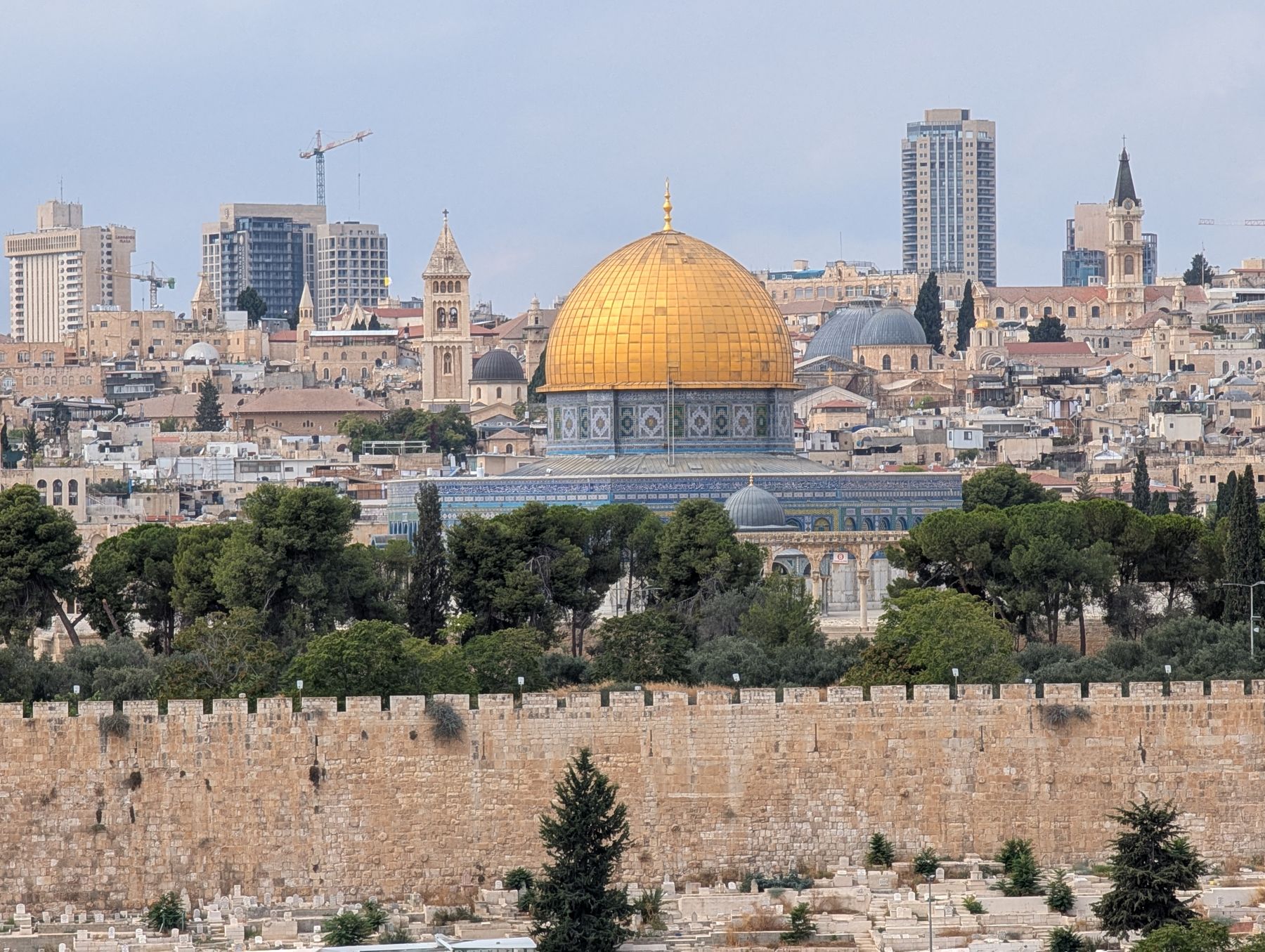
The ridge east of the Old City, with the best view of the Temple Mount and the Dome of the Rock. The Pater Noster Church here displays the Lord's Prayer on tiles in well over a hundred languages. An ancient Jewish cemetery covers the slope.
“So then, this is how you should pray: ‘Our Father in heaven, hallowed be Your name. Your kingdom come, Your will be done, on earth as it is in heaven.”
Pools of Bethesda and St. Anne's
The twin pools lie beside the Crusader Church of St. Anne, built in the 1130s and known for its acoustics. The pools are traditionally identified with the healing in John's Gospel.
“Now there is in Jerusalem near the Sheep Gate a pool with five covered colonnades, which in Hebrew is called Bethesda. ... Then Jesus told him, “Get up, pick up your mat, and walk.””
The Temple Mount and the Dome of the Rock
The platform where Solomon's and later Herod's temples stood, identified with Mount Moriah. The Dome of the Rock was finished in 691 to 692 by the Umayyad caliph Abd al-Malik and is one of the oldest surviving Islamic monuments.
“Then Solomon began to build the house of the LORD in Jerusalem on Mount Moriah, where the LORD had appeared to his father David. This was the place that David had prepared on the threshing floor of Ornan the Jebusite.”
The Golden Gate
The eastern gate of the Temple Mount, sealed since the Ottomans closed it in 1541. Jewish and Christian tradition both link it to the expected coming of the Messiah.
“Lift up your heads, O gates! Be lifted up, O ancient doors, that the King of Glory may enter!”
Pater Noster ChurchThe Dome of the Rock from the Mount of OlivesChurch of St. AnnePools of BethesdaThe Temple MountThe Golden Gate
Beneath the City
Tunnels, cisterns and ancient streets
The Western Wall Tunnels
A walkway runs north along the Temple Mount wall below the modern Old City, past huge Herodian stones and Wilson's Arch.
“Jerusalem is built up as a city united together,”
The City of David
The oldest settled part of Jerusalem, the Jebusite stronghold David captured. Beneath it, Hezekiah's Tunnel carries water about 530 metres from the Gihon Spring to the Pool of Siloam, cut around 700 BC.
“As for the rest of the acts of Hezekiah, along with all his might and how he constructed the pool and the tunnel to bring water into the city, are they not written in the Book of the Chronicles of the Kings of Judah?”
The Pool of Siloam
A first-century pool at the bottom of the City of David, uncovered in 2004. It is the pool of the healing of the blind man.
“Then He told him, “Go, wash in the Pool of Siloam” (which means “Sent”). So the man went and washed, and came back seeing.”
Mount Zion & the Walls
Gethsemane, the Upper Room and the ramparts
The Upper Room and David's Tomb
The Cenacle on Mount Zion is a Crusader-era Gothic hall built on the traditional site of the Last Supper. Below it is a chamber venerated as the tomb of King David.
“And he will show you a large upper room, furnished and ready. Make preparations for us there.””
Gethsemane
The Church of All Nations, completed in 1924 and designed by Antonio Barluzzi, is built around a rock traditionally identified as where Jesus prayed. Its twelve domes represent the twelve nations that paid for it. Ancient olive trees grow in the garden next door.
“Then Jesus went with His disciples to a place called Gethsemane, and He told them, “Sit here while I go over there and pray.””
The Ramparts Walk
A path along the top of the Ottoman city walls, built in the sixteenth century. It looks down into the Old City on one side and across the modern city on the other.
“Then I said to them, “You see the trouble we are in. Jerusalem lies in ruins, and its gates have been burned down. Come, let us rebuild the wall of Jerusalem, so that we will no longer be a disgrace.””
The Upper RoomChurch of All Nations, GethsemaneOn the rampartsWalking the Old City ramparts
Holy Sepulchre
The church at the centre of the Old City
Church of the Holy Sepulchre
Constantine's church, dedicated in 335, stands over the traditional sites of the crucifixion and the empty tomb. Six Christian communities share it. The Edicule over the tomb was restored in 2016 and 2017.
“As the women bowed their faces to the ground in terror, the two men asked them, “Why do you look for the living among the dead? He is not here; He has risen! Remember how He told you while He was still in Galilee:”
Calvary
The upper chapels hold the traditional site of Golgotha, reached by a steep stair near the entrance.
“Carrying His own cross, He went out to The Place of the Skull, which in Hebrew is called Golgotha.”
The EdiculeThe rotunda dome
Heading Home
Back through Ben Gurion
Home
Seventeen days, from Abu Dhabi to the Galilee and back to Jerusalem.
“The LORD will watch over your coming and going, both now and forevermore.”
Heading home from Ben Gurion
180 photos. Select any photo to enlarge; arrow keys move between them. Scripture quotations are from the Berean Standard Bible (public domain). Each verse also links to the NIV on BibleGateway. Site notes are general background, and photo captions were matched from each photo's location data.